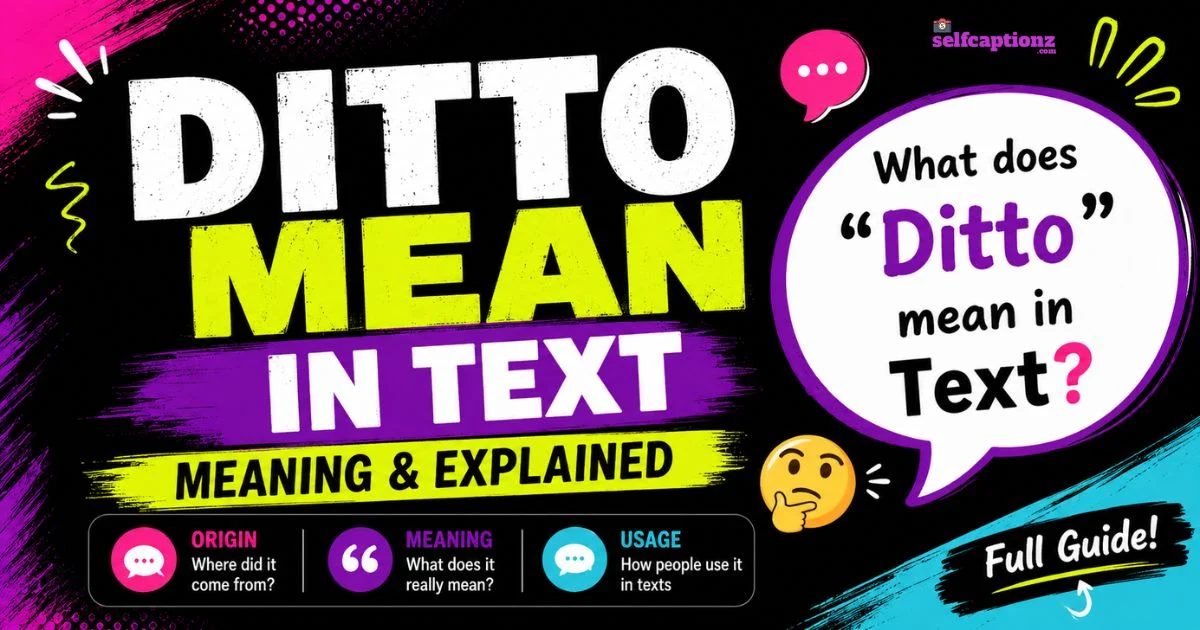
In texting and online chat, “ditto” is a simple but powerful slang term, texting abbreviation (non-acronym), and digital response word used to show agreement, confirmation, or “same here” without repeating the exact message. When someone replies with ditto, they are expressing mutual agreement, shared sentiment, or identical opinion in a fast and minimal way. For example, if one person says “That exam was so hard,” replying “ditto” signals relatable experience and full agreement without extra explanation.
However, the phrase is often misunderstood in text messaging culture because it is not a modern acronym like LOL, FR (for real), or TBH (to be honest). Instead, ditto is a borrowed English word that has evolved into internet slang, commonly used in informal communication, social media chats, and messaging apps like WhatsApp, Instagram DMs, and Snapchat conversations. This creates confusion for users searching for its meaning, especially when trying to interpret whether it indicates agreement, repetition, or emotional alignment.
In today’s Gen Z slang ecosystem and digital communication trends, ditto is valued for its role in short-form expression, low-effort replies, and context-based meaning. It often appears in conversations where users prefer concise responses, tone matching, and natural conversational flow rather than repeating full sentences. Its simplicity makes it a key part of modern texting language evolution, but its subtle usage still leads many users to search for “ditto meaning in text” to avoid misinterpretation in casual chats, group messages, and social media interactions.
What Does “Ditto” Mean in Texting?
In texting, “ditto” is a casual response word used to express agreement, similar opinion, or shared feeling without repeating what was already said. It essentially means “same here,” “I agree,” or “me too.” This makes it a popular part of internet slang, digital communication, and informal messaging language across platforms like WhatsApp, Instagram DMs, Snapchat, and iMessage.
People often use it when they want to respond quickly while keeping the conversation natural and minimal.
Basic Meaning
At its core, ditto = same thing as mentioned before.
In texting context, it usually communicates:
- Agreement with a statement
- Shared emotion or experience
- Repeating someone’s idea without rewriting it
Example:
- Person A: “That test was stressful.”
- Person B: “Ditto.”
➡ Meaning: “I felt the same way.”
This makes it a short-form conversational shortcut in modern text slang.
Why People Use It
People prefer “ditto” in chats because it supports fast communication and reduces effort in replying.
Key reasons include:
- Saves time in conversations
- Avoids repeating the same sentence
- Feels more natural in casual tone
- Works well in group chats and quick replies
- Matches modern Gen Z texting style
In many cases, it also helps maintain flow in digital conversations where short responses are preferred.
Where Did the Word “Ditto” Come From?
The word “ditto” originally comes from the Italian word “detto,” meaning “said.” It entered English through business and writing contexts, where it was used to avoid repeating the same word or phrase.
Historical usage:
- Used in bookkeeping to mark repeated entries
- Appeared in printed lists to indicate “same as above”
- Later adopted in everyday spoken English
Over time, it shifted from formal writing into casual speech and texting language.
Read More: ISK Mean in Text: Definition, Usage, and Examples 2026
Historical Roots
Historically, ditto was not slang—it was a practical writing tool.
It was commonly used in:
- Accounting records
- Forms and ledgers
- Official documents
Instead of rewriting the same word repeatedly, people simply wrote “ditto” or (“) marks to indicate repetition. This efficiency-based origin explains why it still means “the same as above” today.
Evolution Into Speech
As communication evolved, ditto transitioned from formal writing into spoken language.
Key stages of evolution:
- Written shorthand → business usage
- Formal English expression → conversational word
- Everyday speech → digital slang term
In modern usage, it became part of text messaging culture, where users prefer short, expressive responses instead of full sentences.
How “Ditto” Became Popular in the United States
In the United States, ditto gained popularity through casual conversation, media, and pop culture references. One of the biggest boosts came from its use in movies and everyday American English, where it was used as a quick way to express strong agreement.
Cultural adoption factors:
- Common in Hollywood dialogue
- Used in school and college conversations
- Spread through early internet chat rooms
- Became part of modern texting slang
Its simplicity helped it blend easily into American digital communication style.
Cultural Adoption
Today, ditto is widely recognized in global internet slang, especially among users who prefer minimalist texting.
It is commonly used in:
- Social media replies
- Friend group chats
- Casual workplace messaging
- Online comment sections
Why it stuck:
- Universally understood meaning
- Works across different contexts
- No need for grammar or sentence structure
- Feels natural in fast-paced conversations
Common Situations Where People Use “Ditto”
“Ditto” appears in everyday digital conversations where users want to quickly mirror someone’s statement.
Everyday examples:
- Agreeing with opinions
- Sharing emotions
- Reacting to experiences
- Responding in group chats
Sample conversation:
- A: “I’m so tired today.”
- B: “Ditto.”
➡ Both feel the same exhaustion.
Tone and context:
- Usually casual
- Can be friendly or neutral
- Rarely used in formal communication
- Depends heavily on conversation context
It works best when the message is already clear and doesn’t need expansion.
Read More: LMY Meaning in Chat: Usage and Examples 2026
“Ditto” vs “Same” vs “Me Too”
These three expressions are often confused in texting slang, but they carry slightly different tones.
| Term | Meaning | Tone | Usage Context |
| Ditto | Same as above / full agreement | Casual, slightly polished | Replies in chats, comments |
| Same | I feel the same | Very casual | Quick reactions |
| Me too | I also feel/do this | Friendly, emotional | Personal experiences |
Key difference:
- “Ditto” feels more neutral and concise
- “Me too” feels more emotional and personal
- “Same” is the most informal and reactive
Understanding these differences helps avoid misinterpretation in digital conversations and improves clarity in text messaging communication.
Comparison Table
| Aspect | Ditto | “Same” | “Me Too” |
| Core Meaning | Full agreement / same as above | Quick informal agreement | Personal shared experience |
| Tone | Neutral, slightly polished | Very casual | Friendly, emotional |
| Context | Texts, social media, replies | Chat, quick reactions | Conversations, emotional replies |
| Emotion Level | Low–medium emotional intensity | Low emotion | Medium–high emotional expression |
| Usage Style | Single-word echo response | Short slang reply | Sentence-style response |
Emotional and Psychological Meaning of “Ditto”
In digital communication, “ditto” is more than just agreement—it acts as a psychological shortcut for connection. It signals that the speaker is not only agreeing but also mentally aligning with the other person’s thoughts or feelings.
Linguistically, it functions as a form of emotional mirroring, where users reflect someone else’s experience without expanding the conversation. This makes it part of modern relational texting behavior, where brevity still carries meaning.
Emotional Signals
When someone replies with “ditto,” it often carries subtle emotional cues, such as:
- Empathy → “I feel what you feel”
- Validation → “Your statement is correct for me too”
- Relatability → “I’ve experienced the same thing”
- Quiet agreement → No need for extra explanation
- Social bonding → Strengthens conversational connection
In many cases, it replaces longer emotional responses like “I feel the same way” or “I completely agree.”
Why It Feels Good
The reason “ditto” feels satisfying in conversation is linked to cognitive ease and social validation.
It works because:
- It reduces mental effort in replying
- It creates a sense of instant understanding
- It avoids unnecessary repetition
- It maintains conversational flow
- It feels smooth, modern, and efficient in digital slang culture
In group chats and social media interactions, this efficiency makes communication feel more fluid and connected.
How “Ditto” Is Used on Social Media
On platforms like Instagram, TikTok, Snapchat, Facebook, and X (Twitter), “ditto” is widely used as a reaction word.
Modern digital usage includes:
- Commenting “ditto” under relatable posts
- Replying in DMs to agree instantly
- Using it in meme threads to show shared feelings
- Reacting to emotional or humorous content
- Participating in trend-based conversations
Example:
- Post: “Adulting is exhausting 😩”
- Comment: “Ditto.”
This usage makes it a viral-friendly micro-response in online culture.
Read More: TMP Meaning Slang: Definition, Uses, and Examples 2026
Trends Over Time
The usage of “ditto” in communication has evolved significantly:
- Early usage (pre-internet) → Writing shorthand in documents and lists
- 2000s era → Occasional spoken slang in casual English
- 2010–2020 → Decline as “same” and emojis became dominant
- 2020–2026 → Resurgence in TikTok, memes, and Gen Z texting culture
Today, it is experiencing a slang revival, especially in contexts where users prefer minimalist digital expression.
“Ditto” in Pop Culture and Media
“Ditto” has appeared in multiple pop culture layers, strengthening its recognition in modern language.
Cultural moments include:
- Classic movie dialogues where characters say “ditto” to show emotional depth
- Its use in nostalgic references in TV shows
- The character Ditto in Pokémon, which reinforced the idea of copying or mirroring
- Internet memes using “ditto” as a shorthand for agreement
Impact on meaning:
Pop culture has helped shift “ditto” from a formal repetition marker into a casual emotional response word used in everyday speech and texting.
Is “Ditto” Formal or Informal?
Formality Level:
“Ditto” is generally considered an informal language.
It is suitable for:
- Casual texting
- Social media replies
- Friendly conversations
- Informal group chats
It is not typically used in:
- Professional emails
- Academic writing
- Formal business communication
- Official documentation
When to use it:
- When the conversation is relaxed
- When you want a short agreement
- When tone is friendly or conversational
Misunderstandings and Misuse of “Ditto”
Even though it is simple, “ditto” is often misinterpreted.
Common issues:
- Thinking it means sarcasm when it’s neutral
- Assuming it replaces full emotional responses in serious contexts
- Misreading it as dismissive or lazy in formal conversations
- Confusing it with modern slang like “same” or “FR”
Avoiding miscommunication:
- Use it only when context is clear
- Avoid it in sensitive or emotional discussions
- Pair it with emojis if tone needs clarity in casual chats
- Don’t rely on it in professional messaging
How the Meaning of “Ditto” Has Changed Over Time
Then vs Now
| Era | Meaning of “Ditto” | Usage Style |
| Historical usage | “Same as above” in writing and records | Formal, structured |
| Early modern English | Repetition marker in speech and documents | Neutral |
| Early internet era | Casual agreement in chats | Limited slang use |
| 2025–2026 (current) | Emotional shorthand for agreement and relatability | Social media + texting slang |
Current Status (2025–2026)
Today, “ditto” is a revived micro-slang term used in:
- Short-form digital communication
- Gen Z messaging culture
- Meme-driven conversations
- Fast social media interactions
Its modern meaning is less about literal repetition and more about emotional alignment, agreement, and conversational efficiency.
Cross-Cultural Meaning of “Ditto”
Across cultures, “ditto” is widely understood as a universal agreement marker, but its usage frequency and emotional tone vary depending on language habits and digital communication styles. In most English-speaking regions, it simply means “same here” or “I agree,” but in non-English-speaking cultures, it is often interpreted as a borrowed internet slang term rather than a natural part of everyday speech.
In global texting culture, especially in WhatsApp, Instagram, Messenger, and Snapchat, users from different countries use “ditto” mainly in informal digital conversations, where English slang blends into local languages.
Outside the USA
Outside the United States, the use of “ditto” in texting is less common in spoken language but more common online.
Regional patterns:
- UK & Canada → Similar to the US, used casually in chats and comments
- South Asia (Pakistan, India, Bangladesh) → Common in English-based texting, especially among students and professionals
- Europe (non-native English speakers) → Mostly used as internet slang, not spoken language
- East Asia (Japan, Korea, China) → Rare in speech, but understood in online English communities
- Middle East & Africa → Used mainly in social media replies and messaging apps
In most regions, it is seen as a global internet expression rather than a native linguistic habit.
Broader Symbolism
Beyond literal meaning, “ditto” symbolizes repetition, alignment, and shared identity in communication.
It often represents:
- Emotional mirroring → “I feel exactly the same”
- Social alignment → Agreement with group opinion
- Minimalist expression → Saying more with fewer words
- Digital efficiency → Fast communication culture
In modern internet linguistics, it reflects the shift toward low-effort, high-meaning communication, where emotional understanding is implied rather than fully explained.
“Ditto” in Professional and Workplace Communication
In professional settings, “ditto” is rarely used in formal communication, but it can appear in informal workplace chats or internal messaging platforms like Slack or Teams.
Appropriate use:
- Casual team chats
- Quick agreement in brainstorming
- Internal informal discussions
Not recommended for:
- Emails to clients
- Official reports
- HR or management communication
Better professional alternatives:
- “I agree”
- “Same as above”
- “I support this point”
- “Concur”
In workplaces, clarity is preferred over shorthand slang.
How Gen Z and Millennials Interpret “Ditto” Differently
Different generations use and interpret “ditto” in slightly different ways within digital communication.
| Generation | Interpretation | Usage Style |
| Gen Z | Casual slang for agreement, often ironic or minimalist | Very short replies, meme-like tone |
| Millennials | Polite shorthand for “I agree” or “same here” | Slightly more formal, context-based |
Key difference:
- Gen Z uses it as part of fast-paced meme culture and micro-replies
- Millennials use it more as a functional agreement word in conversations
Alternatives to “Ditto” in Text Messages
People often replace “ditto” with other slang or expressions depending on tone and context.
Common alternatives:
- “Same” → Very casual and direct
- “Me too” → Emotional and personal
- “FR” (for real) → Strong agreement
- “Facts” → Emphasizing truth or agreement
- “Likewise” → Polite and neutral
- “I feel you” → Empathetic response
- “Exactly” → Strong agreement
Quick comparison:
- Ditto → Neutral agreement
- Me too → Emotional agreement
- Same → Instant casual reaction
Real-Life Conversation Examples Using “Ditto” in Chats
1: Daily life conversation
- A: “Today was exhausting.”
- B: “Ditto.”
2: School/college chat
- A: “That lecture made no sense.”
- B: “Ditto lol.”
3: Social media comment
- Post: “Monday mornings are the worst 😩”
- Comment: “Ditto.”
4: Group chat agreement
- A: “We should cancel today’s plan.”
- B: “Ditto.”
5: Emotional alignment
- A: “I miss the old days.”
- B: “Ditto.”
These examples show how “ditto” functions as a compact emotional and conversational mirror, making it a staple of modern digital communication.
What does “ditto” mean in texting?
“Ditto” in texting means “same here,” “I agree,” or “me too.” It is used to show agreement without repeating the original message.
Is “ditto” slang or a real word?
“Ditto” is a real English word that has also evolved into internet slang, commonly used in casual digital conversations and messaging apps.
Is “ditto” formal or informal?
“Ditto” is mostly informal language and is commonly used in chats, social media, and texting, but not in formal writing or professional emails.
Can “ditto” be used in workplace communication?
It may appear in informal team chats, but it is not suitable for formal communication. In professional settings, phrases like “I agree” or “same as above” are better.
What is the difference between “ditto” and “me too”?
“Ditto” is a short, neutral agreement, while “me too” is more personal and emotionally expressive, often showing shared experiences.
Is “ditto” still popular in 2025–2026?
Yes, “ditto” is still used in digital chats, memes, and social media, though it is less common than simpler terms like “same” or emoji reactions.
Do people use “ditto” worldwide?
It is understood globally in English-based online communication, especially in texting and social media, but less common in spoken language.
What tone does “ditto” carry in conversation?
“Ditto” usually carries a neutral, calm, and simple tone, showing agreement without strong emotion or emphasis.
Can “ditto” cause confusion?
Yes, it can sometimes feel too brief or unclear, especially in emotional or serious conversations where more explanation is expected.
What are alternatives to “ditto” in texting?
Alternatives include “same,” “me too,” “exactly,” “FR,” “facts,” and “likewise,” depending on the tone and context.
In conclusion, “ditto” is a simple yet powerful expression of agreement in modern texting and online communication. It has evolved from a traditional English word meaning “same as above” into a widely used piece of internet slang that fits perfectly into today’s fast-paced digital conversations. Whether used in chats, social media replies, or casual group discussions, it helps users respond quickly while showing relatability and shared understanding.
Although it is effective in informal settings, “ditto” is not suitable for formal or professional communication, where clearer and more explicit language is preferred. Its continued popularity in 2025–2026 highlights how digital language keeps evolving toward brevity, simplicity, and emotional efficiency, making “ditto” a lasting part of modern online expression.

Hi, I am Leuron Leonard, the author of “selfcaptionz.com”, a platform dedicated to creative captions, meaningful quotes, and engaging text ideas for social media.
Read Next