If you’ve come across “LMY” in a text message, chat, or social media comment and found yourself confused, you’re not alone. Like many modern texting abbreviations, “LMY” can feel unclear because it isn’t as widely standardized as common slang such as “LOL” or “BRB.” In most cases, users search for LMY meaning in text because they are trying to decode whether it represents a phrase, an emotion, or a context-specific shorthand used in casual digital conversations.
In texting culture especially across platforms like Snapchat, Instagram, and WhatsApp—abbreviations evolve quickly, and meanings can shift depending on context, tone, and regional usage. This is why LMY is often misunderstood or misinterpreted. Some users assume it may be a typo or variation of more familiar slang, while others think it could carry emotional or expressive meaning depending on the conversation. The ambiguity makes it a common search term among Gen Z users and anyone trying to keep up with fast-changing internet language.
Understanding “LMY” requires looking beyond a single definition and instead focusing on how it is used in real conversations. In digital communication, context is everything—what comes before and after the term often determines its true intent. This guide breaks down the possible meanings of LMY in text messaging, explains why it appears in online slang, and clears up the confusion so you can interpret it correctly in any chat scenario.
What Does LMY Mean in Texting?
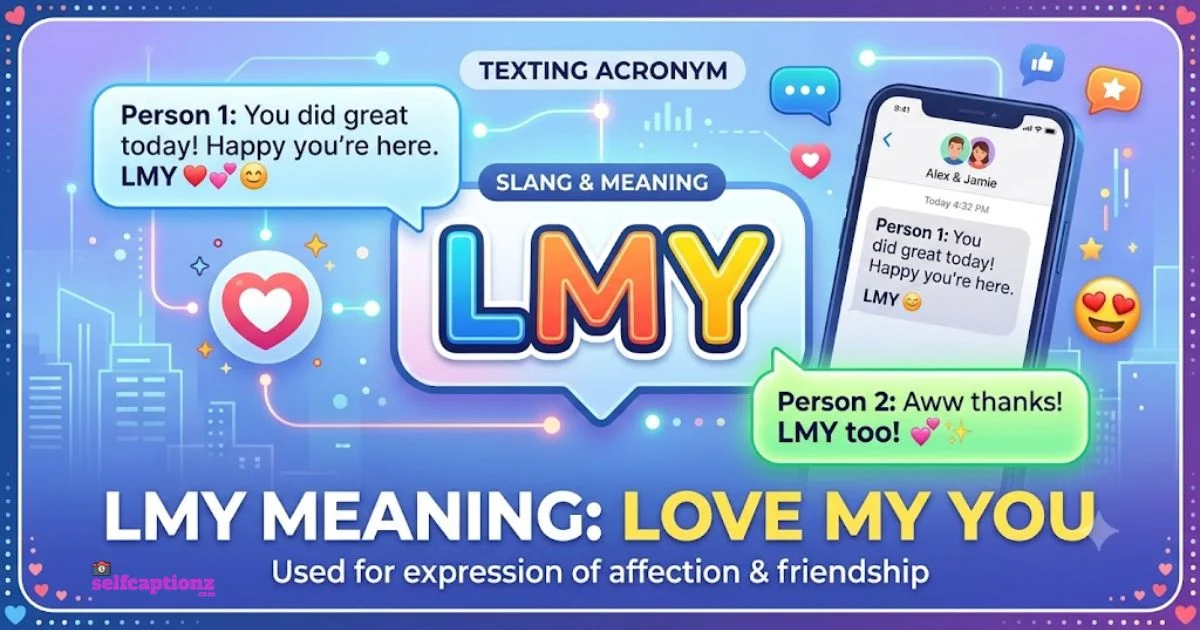
“LMY” in texting is an internet slang abbreviation that is often used in casual digital conversations on platforms like WhatsApp, Snapchat, Instagram, and TikTok. However, its exact meaning is not fully standardized, which is why users frequently search for LMY meaning in text.
In most real-world usage, LMY is commonly interpreted as an emotional shorthand, often connected to phrases like “Love You” or “Love Miss You”, depending on the context of the conversation. Because texting language evolves rapidly, the meaning can shift based on tone, relationship between users, and surrounding messages.
Common Interpretations
The abbreviation LMY can carry multiple meanings depending on how it is used. The most common interpretations include:
- Love You (most frequent emotional usage)
- Love Miss You (less common, contextual)
- Leave Me Yours (rare, situational slang)
- Possible typo or variation of similar acronyms
Because of this variation, LMY is considered a context-sensitive abbreviation, not a fixed-definition acronym.
Why Context Matters
In digital communication, context determines meaning more than the acronym itself. The interpretation of LMY depends on:
- The relationship between sender and receiver
- The tone of the conversation
- The platform being used (Snapchat, Instagram, SMS, etc.)
- Previous and following messages
For example:
- “Goodnight LMY ❤️” → likely affection or emotional closeness
- “LMY, I’ll text later” → could be casual shorthand or typo-like usage
Without context, LMY can easily be misunderstood, which is why clarification is often needed.
The Rise of Text Acronyms in American Culture
Text abbreviations like LMY are part of a larger trend in American digital communication culture, where speed and emotional expression are prioritized.
Common factors driving this rise include:
- Fast-paced messaging habits
- Influence of Gen Z slang
- Social media character limits (historically on platforms like Twitter/X)
- Desire for emotional shorthand in private chats
Other similar acronyms include:
- ILY (I Love You)
- BRB (Be Right Back)
- TTYL (Talk To You Later)
From Early Internet to 2026
The evolution of texting language shows how expressions like LMY emerged from early internet chat culture and evolved into modern messaging behavior.
Timeline overview:
- Early 2000s: Acronyms like LOL, BRB dominate chat rooms
- 2010s: Social media expands slang usage (Instagram, Snapchat)
- 2020s–2026: Hyper-short emotional abbreviations like LMY gain niche use
Today, LMY exists in the grey area of informal slang, often used by younger users or in private conversations rather than formal communication.
The Symbolism Behind LMY
Beyond literal meaning, LMY often carries emotional symbolism. It is used to express:
- Affection
- Emotional closeness
- Informal intimacy
- Soft communication tone
Because it is not rigidly defined, LMY acts more as a feeling-based expression than a strict acronym.
Core Symbolic Ideas
The symbolic interpretation of LMY can be broken down into:
- Emotional shorthand for affection
- Personal connection indicator
- Softening of tone in messages
- Digital intimacy marker
This makes it part of a broader category of emotional texting language used in private messaging.
How LMY Is Used in the United States
In the United States, LMY is primarily seen in informal messaging, especially among teens and young adults.
Common usage scenarios:
- Late-night conversations
- Romantic texting
- Close friendships
- Quick emotional sign-offs
It is rarely used in professional or formal communication due to its ambiguous meaning.
Everyday Contexts
Here are some typical ways LMY appears in daily texting:
- “Talk to you later, LMY”
- “LMY ❤️ goodnight”
- “Didn’t mean that, LMY”
These examples show that LMY is usually placed at the end of a message, functioning like a closing emotional tag
Usage Table
| Context Type | Example Message | Likely Meaning |
| Romantic chat | “Goodnight LMY ❤️” | Love You |
| Casual friendship | “See you tomorrow LMY” | Friendly sign-off |
| Emotional moment | “I miss you LMY” | Love Miss You |
| Unclear context | “LMY I’ll call later” | Ambiguous / typo-like |
Emotional and Psychological Meaning
From a linguistic perspective, LMY reflects emotional compression in digital speech. Instead of writing full sentences, users rely on short forms to express feelings quickly.
Psychologically, it can indicate:
- Desire for emotional closeness
- Comfort in informal digital bonding
- Preference for quick, low-effort emotional expression
What It Communicates
When someone uses LMY, they may be communicating:
- Affection without formality
- Emotional familiarity
- A relaxed relationship tone
- Subtle emotional reassurance
However, because it lacks standardization, misinterpretation is always possible.
LMY in Social Media and Digital Identity
On platforms like Instagram, Snapchat, and TikTok, abbreviations like LMY contribute to a user’s digital identity and communication style.
It is often used in:
- Captions
- Direct messages
- Comments between close users
This reflects how modern communication blends language, emotion, and identity into short-form text expressions.
Modern Digital Behavior
In 2026 digital communication trends, LMY represents the ongoing shift toward ultra-condensed emotional language. Users increasingly prefer:
- Short acronyms over full sentences
- Emotion-driven abbreviations
- Context-based meaning over fixed definitions
As a result, LMY continues to evolve in meaning depending on how and where it is used, making it a flexible but often confusing part of modern texting culture.
Cross-Cultural and Global Interpretations
The meaning of LMY in text messaging is not always universal across cultures, which is why it often creates confusion in global digital communication. In English-speaking countries like the United States, UK, and Canada, it is usually interpreted as an informal emotional shorthand, often linked to affectionate expressions like “Love You.” However, in non-native English-speaking regions, LMY may be completely unclear or interpreted as a typo or random abbreviation.
In global online chats, users often rely on shared internet slang, but acronyms like LMY are highly context-dependent, meaning their interpretation changes based on cultural familiarity with texting abbreviations. This makes it less recognizable compared to widely accepted terms like ILY (I Love You) or BRB (Be Right Back).
Comparable Concepts
To understand LMY better, it helps to compare it with similar digital expressions used worldwide:
- ILY (I Love You) → most direct emotional equivalent
- LY (Love You) → shorter, more common variant
- XOXO → affectionate sign-off (hugs and kisses)
- <3 → symbolic expression of love or affection
- TTYL (Talk To You Later) → casual conversational closure
Compared to these, LMY remains less standardized, which is why it is often misinterpreted or questioned in chats.
LMY in Relationships and Dating
In romantic communication, abbreviations like LMY can carry emotional weight, especially when used between partners who frequently use texting shorthand.
It is often used to:
- Express affection in a quick, casual way
- Maintain emotional closeness in daily chats
- Add warmth without typing full sentences
However, because it is not universally understood, its meaning in dating conversations can vary widely depending on how often the couple uses informal slang.
Romantic Contexts
In romantic settings, LMY is typically used as a soft emotional signal, such as:
- “Goodnight LMY ❤️”
- “LMY, talk later”
- “Miss you LMY”
In these cases, it functions as a light emotional closure or affection marker, rather than a formal declaration of love.
Misunderstandings and Confusion Around LMY
One of the biggest issues with LMY is ambiguity, which often leads to misunderstandings in communication.
Common problems include:
- Misreading it as a typo or incomplete word
- Confusing it with other acronyms like ILY or LMAO
- Not recognizing emotional intent in cross-cultural chats
- Assuming it has a fixed dictionary meaning when it does not
Because of this, LMY can easily be misinterpreted without context clues.
Common Issues
Typical confusion scenarios include:
- A message like “LMY I’ll call later” being misunderstood as unclear or incomplete
- Receiving “LMY” from someone unfamiliar with texting slang
- Assuming emotional intent where none was intended
- Overanalyzing short-form expressions in casual chats
This highlights how modern texting relies heavily on shared digital literacy.
How Meaning Has Shifted Over Time
The interpretation of LMY has evolved alongside internet slang culture.
Then vs Now
- Then (early texting era):
- Slang was more standardized (LOL, BRB, OMG)
- Emotional abbreviations were less ambiguous
- Now (modern messaging era):
- New abbreviations appear constantly
- Meanings are more fluid and context-based
- Emotional shorthand like LMY becomes niche and situational
Today, LMY is less about fixed meaning and more about conversational tone.
Why People Use LMY Instead of Full Phrases
People prefer LMY over full expressions for several practical and emotional reasons:
Key Reasons
- Speed: Faster typing in quick chats
- Convenience: Saves effort in emotional conversations
- Digital habit: Influenced by Gen Z texting culture
- Privacy: Subtle way to express feelings
- Tone softening: Makes messages feel less formal or intense
This reflects a broader trend in modern digital communication efficiency.
Should You Use LMY?
Whether you should use LMY depends on your audience, relationship, and communication style.
When It Works Best
- Between close friends or romantic partners
- In informal chats
- When both users understand slang context
- In emotionally casual conversations
When to Avoid It
You should avoid using LMY when:
- Talking in professional or formal settings
- Messaging someone unfamiliar with slang
- Communicating across cultural or language barriers
- Clarity is important and misunderstandings must be avoided
In such cases, using full phrases like “Love you” or “Talk to you later” is clearer and more effective.
LMY Meaning in Different Messaging Platforms
The interpretation of LMY can vary slightly across messaging platforms, depending on how users communicate and the type of interaction encouraged by each app. On platforms like Snapchat and Instagram, LMY is more likely to appear in casual, emotional conversations, often between close friends or romantic partners. In WhatsApp, it may appear in personal chats as a quick emotional sign-off. Meanwhile, on TikTok, it is usually seen in comments where users express affection or emotional reactions in a condensed form.
Across all platforms, context remains the most important factor, as LMY does not have a fixed universal meaning.
LMY vs Similar Acronyms in Texting Culture
LMY is often compared with other emotional acronyms, but it is less standardized than most. Common comparisons include:
- ILY (I Love You) → clear and widely understood
- LY (Love You) → more common shorthand
- XOXO → affectionate sign-off
- LMAO → unrelated humor-based acronym
Unlike these, LMY lacks a universally accepted definition, which makes it more context-dependent and sometimes confusing in digital conversations.
Possible Alternate Expansions of LMY
Because LMY is not strictly defined, users interpret it in different ways, including:
- Love Miss You (emotional, affectionate usage)
- Leave Me Yours (rare and situational)
- Let Me You (incorrect but occasionally assumed typo-based reading)
- Random or mistyped abbreviation in fast texting
In reality, most interpretations depend entirely on conversational context, not dictionary meaning.
How Gen Z Interprets LMY in Digital Chats
Among Gen Z users, LMY is usually seen as an informal emotional expression rather than a structured acronym. It is often interpreted based on tone rather than literal meaning.
Typical Gen Z interpretation:
- Affectionate shorthand
- Casual emotional signal
- Soft version of “I care” or “love you”
- Used in fast-paced texting culture where brevity matters
For younger users, LMY is less about definition and more about vibe and emotional intent
Is LMY Considered Slang or Internet Language?
Yes, LMY is considered internet slang, but it falls into a more ambiguous category of emergent digital language.
It is:
- Not officially standardized
- Not widely documented in formal slang dictionaries
- Used primarily in informal online communication
- Dependent on context and user familiarity
This makes LMY part of evolving internet language rather than fixed slang.
Real-Life Examples of LMY in Conversations
Here are common ways LMY appears in real chats:
- “Goodnight LMY ❤️”
- “LMY, talk tomorrow”
- “Don’t worry, LMY”
- “LMY I’ll text you later”
These examples show that LMY is often placed at the end or middle of emotional messages, acting as a soft affectionate marker.
Positive vs Negative Usage of LMY
The meaning of LMY can shift depending on tone and context.
Positive Usage
- Expresses affection and closeness
- Strengthens emotional connection
- Used in friendly or romantic conversations
Negative or Confusing Usage
- Can seem unclear or ambiguous
- May be mistaken for a typo
- Might feel emotionally inconsistent if context is missing
Overall, LMY is usually positive but highly context-sensitive.
How Tone Changes the Meaning of LMY
In digital communication, tone is everything, and LMY is no exception.
- Warm tone → “LMY ❤️” = affection
- Neutral tone → “LMY, talk later” = casual sign-off
- Confused tone → may appear as a mistake or unclear abbreviation
Without emojis or context, LMY can easily lose emotional clarity.
LMY in Private Messages vs Public Comments
The usage of LMY differs between private and public communication:
Private Messages
- More intimate and emotional
- Often used between close contacts
- Carries stronger personal meaning
Public Comments
- Used as light emotional expression
- Often symbolic or casual
- Less personal, more performative
This difference shows how digital context shapes emotional language usage.
Role of LMY in Modern Emotional Expression
In modern texting culture, LMY reflects the shift toward compressed emotional language. Instead of writing full sentences, users rely on short expressions to convey feelings quickly.
It represents:
- Emotional efficiency
- Digital intimacy
- Casual affection in online spaces
- Evolution of language in messaging apps
This makes LMY part of a broader trend in modern emotional communication.
How to Respond When Someone Says LMY
If someone sends you “LMY”, your response depends on context:
- Romantic context: “Love you too ❤️” or “LMY too”
- Friendly context: “Talk soon 😊”
- Unclear context: Ask for clarification politely
- Neutral tone: Mirror the casual style of the conversation
The key is to match the emotional tone of the sender to avoid misunderstanding.
LMY in Memes and Internet Culture
In meme culture and online humor, LMY occasionally appears as a playful or ironic expression. Users may use it:
- In exaggerated emotional captions
- As a sarcastic twist on affectionate slang
- In meme text overlays about relationships
- As part of Gen Z humor involving texting abbreviations
In this space, LMY becomes less about meaning and more about stylistic expression and humor.
The Future of Acronyms Like LMY in Communication
The future of LMY and similar texting acronyms is closely tied to how digital communication continues to evolve. As messaging becomes faster and more visual across platforms like Snapchat, Instagram, and WhatsApp, users are increasingly favoring short, emotionally charged expressions over full sentences.
However, the trend is also shifting toward even more visual communication, such as emojis, GIFs, and stickers. This means acronyms like LMY may become less dominant over time, but not disappear completely. Instead, they are likely to:
- Remain in private, emotional conversations
- Be replaced in public spaces by visual expressions
- Evolve into more standardized forms or fade into niche usage
- Continue existing as part of Gen Z digital slang archives
In short, the future of LMY is evolutionary, not fixed, shaped by changing user behavior and platform design.
Mistakes People Make When Using LMY
One of the biggest issues with LMY is misuse due to misunderstanding or assumption of meaning. Because it is not universally standardized, users often make communication errors that lead to confusion.
Common mistakes include:
- Assuming LMY always means “Love You” without context
- Using it in formal or professional messages, where it feels inappropriate
- Sending it to people unfamiliar with internet slang, causing confusion
- Misplacing it in sentences where emotional tone is unclear
- Confusing it with similar acronyms like ILY or LMAO
Another frequent mistake is overusing LMY in emotionally sensitive conversations, where clarity is more important than shorthand. In such cases, full expressions like “I love you” or “I miss you” are far more effective.
Ultimately, the main mistake is ignoring the fact that context defines meaning, not the acronym itself.
Expert Linguistic View on LMY Usage
From a linguistic perspective, LMY represents a form of emergent digital micro-language—a type of expression that develops organically within online communities rather than through formal language rules.
Experts in internet linguistics and sociolinguistics view acronyms like LMY as examples of “context-dependent emotional compression”, where users reduce full emotional phrases into compact, efficient symbols.
Key linguistic insights include:
- Pragmatic meaning overrides literal meaning
- Interpretation depends on social relationship and tone
- Acronyms function as emotional signals, not fixed definitions
- Ambiguity is intentional in some digital communication styles
In this sense, LMY is less about dictionary meaning and more about interactional meaning—what it does in conversation rather than what it stands for. Linguistically, it reflects how modern communication prioritizes speed, emotional expression, and shared context over grammatical precision.
As digital language continues to evolve, expressions like LMY will remain important case studies in how humans adapt language to technology-driven communication environments.
FAQs About LMY Meaning in Text
1. What does LMY usually mean in text messages?
LMY is most commonly understood as an emotional shorthand, often interpreted as “Love You” depending on context.
2. Is LMY a fixed acronym with one meaning?
No, LMY is not a standardized acronym, and its meaning can change based on conversation and relationship.
3. Can LMY mean something different in different chats?
Yes, context is very important, and LMY may be interpreted differently depending on tone and situation.
4. Is LMY considered slang or internet language?
Yes, LMY is informal internet slang, mainly used in casual digital communication.
5. Is LMY used in professional conversations?
No, LMY is not suitable for professional or formal communication due to its ambiguity.
6. Why do people use LMY instead of full words?
People use LMY for speed, emotional expression, and convenience in quick texting.
7. Can LMY be misunderstood?
Yes, LMY is often misunderstood because it has no fixed meaning and relies heavily on context.
8. Is LMY popular among Gen Z users?
Yes, Gen Z users often use LMY as part of informal texting culture, especially in private chats.
9. How should I respond when someone says LMY?
You can respond with “Love you too” or mirror the tone, depending on your relationship with the sender.
10. Is LMY still commonly used in 2026?
Yes, but its usage is niche and context-based, mostly seen in informal or emotional conversations.
Conclusion
In conclusion, LMY is a flexible and context-driven texting abbreviation that does not have one fixed meaning. It is mainly used in informal digital communication to express affection or emotional closeness, but its interpretation depends heavily on tone, relationship, and platform. While it is popular in casual chats—especially among Gen Z users on apps like Snapchat, Instagram, and WhatsApp—it is not suitable for formal communication due to its ambiguity.
As digital language continues to evolve, LMY represents how modern texting prioritizes speed, emotion, and context over strict definitions, making it a small but interesting part of internet slang culture.

Hi, I am Leuron Leonard, the author of “selfcaptionz.com”, a platform dedicated to creative captions, meaningful quotes, and engaging text ideas for social media.
Read Next