XD Meaning in Text can leave many people wondering what it means when they see it in a message or comment online. This social media slang appears often on Snapchat, TikTok, Instagram, and online chat spaces, but users may not know if it feels friendly, rude, funny, or worth replying to.
This guide explains the XD text meaning in a way and helps beginners understand this internet slang and texting abbreviation. You will learn its meaning, real examples, Snapchat meaning, how to reply, and when to use or ignore it during conversations.
Whether you are new to TikTok slang or trying to understand modern chats, this article provides a trustworthy answer about what it means and why people use it today, while revealing details you may not expect.
What Does XD Mean in Text?
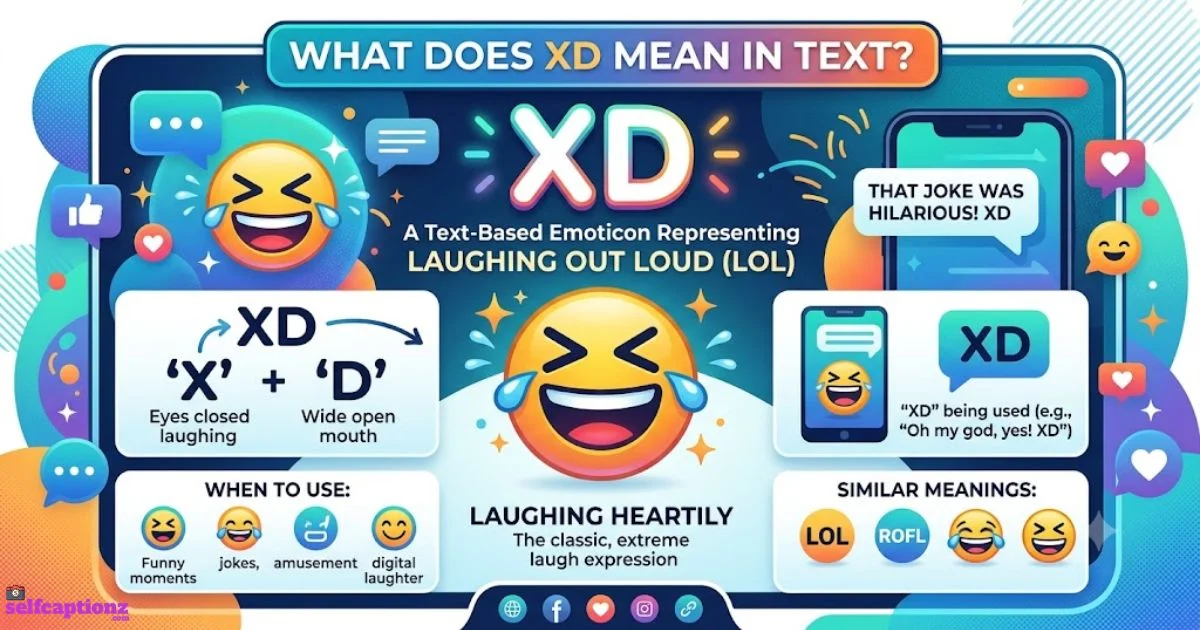
XD means a big laugh, amusement, or finding something extremely funny in text conversations. It is an old-school internet slang expression that combines a closed “X” shape for squinted eyes and a wide “D” shape for a smiling mouth.
People use XD in texting, chats, comments, and social media posts to show that they are laughing or reacting happily to something. It works like saying “LOL,” “haha,” or “that’s hilarious,” but it often feels more playful and expressive.
The meaning of XD in text messages depends on the conversation. Sometimes it shows genuine laughter, while other times it simply adds a fun or joking tone to a message.
For example, a friend might send:
“You really forgot your own birthday? XD”
Here, XD shows that the person finds the situation funny, not that they are being rude.
Example
Here are some common examples of how people use XD in conversations:
- “That movie ending was so unexpected XD”
Meaning: The person found the ending funny or surprising. - “You spilled coffee again? XD”
Meaning: They are teasing in a friendly way. - “I finally finished my homework XD”
Meaning: They feel happy or relieved. - “Your joke was terrible XD”
Meaning: They are joking around and laughing at the situation.
Unlike some texting abbreviations, XD does not have a fixed serious meaning. It mainly works as an emotional reaction that shows laughter, excitement, or playful energy. Understanding the conversation around it helps you know the exact tone.
XD Full Form and Definition
The full form of XD is not an abbreviation with official words behind it. Instead, XD is an emoticon that represents a laughing face when viewed sideways. It became popular in early online chats, gaming communities, forums, and instant messaging.
The symbol uses two characters:
- X = tightly closed or happy eyes
- D = an open mouth smiling or laughing
When turned sideways, XD looks like a face laughing with its eyes squeezed shut. Over time, internet users started using it as a quick way to show humor or excitement.
The XD meaning in texting is similar to other internet reactions like “LOL,” “LMAO,” and “ROFL,” but XD has a more visual and playful style. Many people use it because it feels more expressive than simply writing “haha.”
Breakdown of XD
The meaning of each part of XD comes from its appearance rather than a written phrase:
- X: Represents closed eyes from laughing hard.
- D: Represents a wide-open smiling mouth.
- XD together: Creates the image of a person laughing.
This type of expression is called an emoticon, which uses keyboard characters to show emotions. Before modern emojis became common, people used symbols like XD, 🙂 , 😉 , and 😀 to add feelings to online messages.
Today, younger users may use XD less often than emojis, but it still appears in gaming chats, memes, online communities, and casual conversations.
XD Meaning Slang
As slang, XD means “that is funny,” “I’m laughing,” or “this is amusing.” It often appears after a joke, funny comment, teasing statement, or surprising moment.
The tone of XD can change depending on who uses it and how they write it:
- Friendly use: Shows laughter between friends.
- Playful use: Adds humor to teasing or jokes.
- Sarcastic use: May exaggerate laughter or make fun of a situation.
For example:
“You thought the meeting was today? XD”
This could mean the person is laughing at a small mistake in a friendly way.
However, using XD in professional conversations may not always fit because it has a casual internet slang style. In work emails or formal messages, words like “That’s funny” or a simple smile emoji may sound more appropriate.
Understanding XD slang meaning helps you read online conversations better and respond with the right tone. It is mainly a fun expression that shows emotion rather than a word with a strict definition.
Read More: ASH Meaning in Text: Definition, Uses & Examples 2026
What Does XD Stand For?
XD stands for a laughing or happy face expression used in online communication. Unlike common abbreviations such as “LOL” or “BRB,” XD does not represent a specific phrase or group of words. It is an emoticon made from keyboard characters that shows laughter or amusement.
The “X” in XD represents tightly closed eyes, while the “D” represents a wide smiling mouth. When turned sideways, the two letters look like a face laughing with its eyes squeezed shut.
People use XD in text messages, gaming chats, social media comments, and online communities to show that something feels funny, silly, or entertaining. It often adds emotion to a message and helps the reader understand the sender’s playful tone.
For example:
“You actually watched that whole series in one night XD”
In this sentence, XD shows that the sender finds the situation funny or surprising. It does not mean they are criticizing the person.
Although XD became popular years ago in internet culture, many people still recognize it today. Some users prefer emojis like 😂 or 🤣, but XD remains a familiar way to express laughter in casual conversations.
Origin and Background of XD
XD originated as an internet emoticon used to represent a laughing face before modern emojis became popular. It became widely recognized during the growth of online chats, forums, instant messaging, and gaming communities in the early internet era.
Like other classic emoticons such as 🙂 and :D, XD used simple keyboard characters to express emotions. Users created these symbols because early communication platforms did not have the colorful emojis available on smartphones today.
When viewed sideways, XD resembles a face laughing with closed eyes and a wide-open smile. This visual idea made it easy for people to understand the emotion behind the symbol.
Over time, XD became part of online slang and internet culture. While its popularity has changed with newer forms of digital expression, many people still recognize it as a symbol of laughter and fun.
How to Reply When Someone Sends XD
When someone sends XD in a text conversation, your reply depends on the situation and your relationship with that person. Since XD usually shows laughter or a playful mood, you can respond with humor, continue the joke, or simply acknowledge their reaction.
There is no single correct reply to XD. A good response matches the energy of the conversation and keeps the chat natural.
Funny Replies to XD
If someone uses XD after a joke or funny comment, you can reply with another playful message. Funny responses work well when you already have a casual relationship with the person.
Examples:
- “Glad I could make you laugh.”
- “That reaction says everything.”
- “I knew you would find that funny.”
- “Your XD is louder than words.”
- “Mission accomplished, I made you laugh.”
You can also continue the joke instead of directly answering. A creative response often keeps the conversation more entertaining.
For example:
Friend: “You forgot your keys again XD”
Reply: “My keys and I are taking separate journeys now.”
The goal is not to explain XD but to match the playful tone behind it.
Friendly Replies to XD
For normal conversations, a simple and friendly response works best. You can acknowledge their laughter or move the conversation forward.
Examples:
- “Haha, I knew you’d laugh.”
- “Right? That was funny.”
- “I’m glad you enjoyed it.”
- “You always understand my jokes.”
- “Haha, exactly!”
If the person sends XD after sharing something funny, you can also respond with your own reaction. This keeps the conversation warm and natural.
For casual chats, using another laugh expression, emoji, or friendly comment can make the conversation feel more engaging.
When Not to Reply to XD
You do not always need to reply when someone sends XD. Sometimes it works as a reaction rather than a message that requires an answer.
You may not need to respond when:
- The conversation has already ended naturally.
- XD appears as a reaction to your joke or comment.
- The sender uses it as a quick expression of amusement.
- A reply would feel forced or unnecessary.
For example:
You: “I finally cleaned my room.”
Friend: “XD”
In this case, the person may simply be laughing or reacting. You can leave it there or continue if you have something else to say.
Understanding the context helps you decide whether to reply, joke back, or simply move on. The best response always depends on the relationship, conversation style, and overall tone.
Common Mistakes People Make When Using XD
While XD is a simple way to show laughter online, some people use it in ways that can create confusion. Understanding the right tone and situation helps you avoid awkward conversations.
One common mistake is using XD in serious or professional messages. Since XD has a playful and casual feeling, it may not fit in emails, workplace chats, or formal discussions. A simple “thank you” or a professional response usually works better in those situations.
Another mistake is assuming that XD always means someone is laughing at you. In most cases, XD shows amusement, not disrespect. The meaning depends on the conversation, relationship, and tone between the people involved.
Some users also overuse XD by adding it to every message. Repeating it too often can make conversations feel less natural. Like other internet slang, it works best when used at the right moment.
People also sometimes confuse XD with other expressions like LOL, XOXO, or emojis. While these can all show emotions, they do not carry the exact same feeling. XD usually gives a stronger impression of playful laughter or a joking reaction.
To use XD correctly, consider the situation, the person you are talking to, and whether the message needs a casual or formal tone.
Read More: ALR Meaning in Text: Definition, Uses & Examples 2026
XD Meaning for Different Age Groups
The meaning and popularity of XD in text messages can change depending on a person’s age and online experience. Different generations use internet slang in different ways based on the platforms they grew up with.
Younger users may see XD as an older internet expression, while older online users may recognize it as a classic symbol from early chat rooms, gaming spaces, and forums.
Teenagers and Gen Z Usage
| Situation | How Teenagers and Gen Z May Use XD |
| Casual chats | Used as a playful reaction to something funny or unexpected |
| Gaming conversations | Shows laughter after a funny moment or mistake |
| Memes and comments | Adds a joking or ironic tone |
| With friends | Used to tease, joke, or show amusement |
| Modern texting | Often replaced by emojis like 😂 or 💀 but still understood |
Many teenagers and Gen Z users recognize XD meaning in slang, but they may not use it as frequently as older internet users. Some consider it a nostalgic or “old internet” expression.
However, XD can still appear in gaming communities, online groups, and conversations where people enjoy classic internet humor.
◆ ◆ ◆
Older Internet Users and XD
| Situation | How Older Internet Users May Use XD |
| Early online chats | Used as a common laughing emoticon |
| Forums and message boards | Added to jokes and funny comments |
| Gaming communities | Used to show excitement or laughter |
| Personal messages | Replaces written laughter like “haha” |
| Internet nostalgia | Represents classic online culture |
For many older internet users, XD represents a familiar part of early digital communication. It became popular before modern emojis were widely available, making it one of the recognizable symbols of internet slang history.
Today, both younger and older users can understand XD, but the feeling behind it may differ. For some, it is a normal laughing expression, while for others, it feels like a nostalgic reminder of early online conversations.
◆ ◆ ◆
XD Compared With 😂 and 🤣 (Table)
XD, 😂, and 🤣 all show laughter, but they create different feelings in a conversation. XD has a classic internet slang style, while 😂 and 🤣 are modern emojis that show stronger emotional reactions.
| Expression | Meaning | Tone | Common Use |
| XD | Shows laughter, amusement, or a playful reaction | Casual, nostalgic, joking | Texts, gaming chats, online communities |
| 😂 | Shows laughing with tears | More expressive and widely used | Social media, messages, comments |
| 🤣 | Shows extreme laughter or something very funny | Stronger than regular laughter | Funny posts, jokes, hilarious situations |
The main difference is the style. XD feels more like classic internet humor, while 😂 and 🤣 feel more like visual reactions. Someone using XD may be joking in a playful way, while someone using 🤣 may be saying something is extremely funny.
For example:
- “You forgot your password again XD”
Shows playful teasing. - “That video was so funny 😂”
Shows normal laughter. - “I cannot stop laughing at this 🤣”
Shows a stronger reaction.
There is no right or wrong choice between them. The best option depends on the conversation style and the emotion you want to express.
Read More: Gen Z Meaning in Text: Simple Explanation With Examples 2026
How to Use XD Correctly in Text Messages
Using XD correctly in text messages means knowing when it matches the mood of the conversation. Since XD is a casual internet expression, it works best in friendly and relaxed chats.
You can use XD after a funny comment, a joke, a surprising moment, or a playful statement. It helps show that you are laughing and keeps the message from sounding too serious.
Examples:
- “You really did that XD”
- “That was the funniest thing today XD”
- “I can’t believe you said that XD”
Avoid using XD when you want to sound formal, professional, or serious. The expression adds a playful tone, so it may not fit every situation.
Using XD With Friends
Using XD with friends is one of the most common ways to use it. It can make conversations feel more relaxed and show that you are joking or having fun.
Friends often use XD while teasing each other, sharing funny stories, or reacting to unexpected moments.
Example:
Friend: “I watched the whole season in one day.”
Reply: “You had no other plans XD”
Here, XD shows friendly humor rather than criticism.
When chatting with close friends, XD can help add personality to your messages. It works best when both people understand the playful tone.
Using XD in Group Chats
In group chats, XD can help you quickly show that you found a message funny. It works well when several people are sharing jokes, memes, or funny updates.
For example:
Group member: “I accidentally sent my homework to the wrong person.”
Reply: “That is a classic mistake XD”
However, remember that different people may understand slang differently. In larger groups, some members may prefer emojis or simple words like “haha” because they feel more natural.
Using XD occasionally keeps group conversations fun without making your messages feel repetitive.
Using XD With Online Friends
XD is also common among online friends, especially in gaming communities, forums, and social platforms. It helps people show emotions when they cannot use facial expressions or voice tone.
Online friends may use XD after funny gameplay moments, jokes, mistakes, or surprising events.
Examples:
- “You missed that easy shot XD”
- “That game was wild XD”
- “Your character’s outfit is amazing XD”
Because online conversations lack body language, expressions like XD help communicate mood. They show that the message is playful and should not be taken too seriously.
Is XD Rude, Offensive, or Neutral?
XD is usually a neutral and friendly expression that shows laughter or amusement. In most conversations, it is not rude or offensive. The meaning depends on the context, the relationship between people, and the way it appears in a message.
When someone uses XD, they usually want to show that they are joking, laughing, or reacting playfully. However, like any form of internet slang, the tone can change depending on the situation.
For example, “That was a funny mistake XD” sounds playful between friends. But “You failed again XD” could feel annoying if the person uses it to mock someone.
Understanding the conversation around XD is important. The expression itself is harmless, but the message around it determines whether it feels friendly, sarcastic, or disrespectful.
When XD Feels Friendly
XD feels friendly when people use it to share laughter, make jokes, or create a relaxed mood. Friends often add XD to messages to show they are teasing in a lighthearted way.
Common friendly uses include:
- Reacting to a funny story
- Laughing at a harmless mistake
- Making playful comments
- Showing excitement or amusement
Example:
“You actually finished that game in one day XD”
Here, XD shows surprise and humor. The sender is likely joking, not criticizing.
Among friends and online communities, XD can make conversations feel more casual. It helps replace facial expressions or tone of voice that people normally use during face-to-face conversations.
When XD Might Feel Annoying
Although XD is usually harmless, some people may find it annoying when it appears too often or in the wrong situation. The reaction depends on the person and the conversation.
XD might feel negative when:
- Someone uses it after an insult or criticism
- It appears repeatedly in every message
- A serious topic gets a joking response
- The sender uses it to laugh at someone instead of with them
Example:
“You made the same mistake three times XD”
Depending on the relationship, this could feel like friendly teasing or like the person is making fun of someone.
Some people also view XD as an older internet slang term, so they may find it outdated or less natural compared with modern emojis. However, this is more about personal preference than the meaning of the expression.
Example
The meaning of XD changes based on the situation:
Friendly example:
“You forgot your umbrella again XD”
Meaning: The person is joking in a playful way.
Annoying example:
“You don’t know how to do this XD”
Meaning: It may sound like the person is laughing at someone.
Neutral example:
“That movie ending was unexpected XD”
Meaning: The person found the situation funny or surprising.
Overall, XD is not naturally rude or offensive. It is a casual laughing expression that usually creates a fun tone. The best way to understand it is to look at the full message and the relationship between the people chatting.
Read More: BB Meaning in Text: Uses, Examples, and More Guide 2026
Where Is XD Commonly Used?
XD is commonly used in casual online conversations where people want to show laughter, humor, or a playful reaction. It became popular through early internet communication and still appears in many online spaces today.
People use XD in text messages, social media comments, gaming chats, forums, and online communities. It works especially well in conversations where users share jokes, funny moments, memes, or personal stories.
Although newer emojis like 😂 and 🤣 are more common today, XD remains recognizable because of its connection to classic internet culture. Many users still use it when they want a more playful or nostalgic style.
Popular Platforms
XD can appear across different online platforms, especially where casual conversations happen. Common places include:
| Platform Type | How XD Is Used |
| Messaging apps | Added to texts to show laughter or joking |
| Social media | Used in comments, replies, and casual posts |
| Gaming chats | Shows reactions to funny moments or mistakes |
| Online forums | Used to respond to jokes and discussions |
| Community groups | Adds a friendly and humorous tone |
Gamers and online communities often use XD because text-based conversations do not show facial expressions or emotions. Adding XD helps make a message feel more playful and less serious.
Why People Use XD
People use XD in texting because it quickly adds emotion and personality to a message. Written conversations can sometimes feel flat, so expressions like XD help show the sender’s mood.
Instead of writing a long explanation like “I am laughing because that was funny,” someone can simply add XD to show amusement.
Main Reasons
People commonly use XD for these reasons:
- To show laughter: It tells others that something is funny.
- To make jokes feel playful: It softens teasing and casual comments.
- To show excitement: It can express a happy or energetic reaction.
- To add personality: It makes messages feel more emotional.
- To create a friendly tone: It helps avoid messages sounding too serious.
XD also helps people communicate feelings in online conversations where they cannot use facial expressions, voice tone, or body language.
Example
Message: “I just realized I was wearing my shirt backward all day XD”
The XD shows that the person is laughing at their own mistake and sharing the moment in a funny way.
Another example:
Friend: “You watched the entire series overnight?”
Reply: “Yes, I couldn’t stop XD”
Here, XD adds a playful feeling and shows that the person is joking or enjoying the conversation.
Overall, people use XD because it is a simple way to add humor, emotion, and a casual internet style to everyday messages.
Real-Life Examples of XD Usage
XD can have different meanings depending on the situation, the relationship between people, and the overall tone of the conversation. Most of the time, it shows laughter or a playful reaction, but the feeling behind it can change from friendly to sarcastic.
Looking at real-life examples makes it easier to understand how people use XD in text messages, online chats, and social media conversations.
Friendly Tone
In a friendly conversation, XD usually shows laughter, happiness, or playful teasing. Friends often use it after a funny comment or a harmless joke.
Examples:
Person A: “I forgot my keys again.”
Person B: “You and your keys have a complicated relationship XD”
Here, XD shows that the person is joking in a caring way. It adds humor without making the other person feel bad.
Another example:
“Your cooking actually turned out great XD”
The sender is likely surprised and happy. The expression keeps the message light and positive.
Casual Conversation
In everyday texting, people use XD as a quick reaction to something funny or unexpected. It can replace words like “haha” or “that’s funny.”
Examples:
“I woke up five minutes before my alarm today XD”
“I just found money in my old jacket XD”
In these situations, XD shows a small moment of amusement. It keeps casual conversations relaxed and natural.
People often use XD with friends, classmates, or online contacts because it creates a more personal feeling than a plain text response.
Gaming Context
Gaming communities commonly use XD to react to funny mistakes, surprising moments, or exciting events during gameplay.
Examples:
“You jumped into the wrong area again XD”
“That was the luckiest win ever XD”
In gaming chats, XD often shows friendly competition rather than anger. Players use it to laugh together and make the experience more enjoyable.
However, the meaning depends on the players involved. Between friends, it feels playful, but between strangers, it may sometimes be misunderstood.
Social Media Context
On social media, people may use XD in comments, replies, and posts to show amusement. It often appears under funny videos, memes, or entertaining content.
Examples:
“This video gets funnier every time XD”
“The dog’s reaction was perfect XD”
Here, XD works as a quick emotional response. It tells others that the person enjoyed the content or found it funny.
Some users also use XD for nostalgic internet humor, especially when referencing older online culture.
Argumentative or Sarcastic Tone
Although XD is usually friendly, it can sometimes appear in sarcastic or negative situations. The meaning changes when someone uses it to mock, criticize, or laugh at another person.
Examples:
“You really thought that would work XD”
“You believed that story XD”
In these cases, XD may feel less like friendly laughter and more like someone making fun of another person.
The surrounding words matter more than the symbol itself. A message with XD can be kind, funny, or sarcastic depending on the sender’s intention and the relationship between the people involved.
Understanding the context helps you read the true meaning behind XD and respond in the right way.
Read More: HYY Meaning in Text: Definition, Origin, and Usage 2026
Comparison Between XD and Similar Slang
XD is one of many internet expressions used to show laughter, but each slang term has a slightly different tone and purpose. Understanding these differences helps you choose the right reaction for different conversations.
| Slang | Meaning | Tone | Common Use |
| XD | Shows laughter or amusement | Playful, casual, nostalgic | Chats, gaming, online communities |
| LOL | Laughing out loud | Simple and common | Everyday texting and comments |
| LMAO | Laughing very hard | Stronger and more expressive | Funny situations and jokes |
| ROFL | Rolling on the floor laughing | Extreme humor reaction | Very funny moments |
| 😂 | Face with tears of joy | Emotional and visual | Social media and messages |
| 🤣 | Rolling on the floor laughing emoji | Very strong laughter | Hilarious content |
The main difference is the style behind each expression. XD feels more like classic internet slang, while LOL and emojis are more common in modern conversations.
For example, someone might write “That was funny XD” to add a playful old-school internet feeling. Another person may use “That was funny 😂” because emojis feel more natural in current texting.
Choosing between these expressions depends on your personal style, the platform, and the person you are communicating with.
Is XD Safe for Social Media?
XD is generally safe to use on social media because it is a harmless expression of laughter or amusement. It does not contain offensive language, harmful meaning, or inappropriate content by itself.
People commonly use XD in comments, replies, and messages to react to funny posts, jokes, memes, and entertaining videos. It is usually understood as a friendly or playful reaction.
However, the meaning can change based on the message around it. Using XD after a negative comment, insult, or argument may make the message appear sarcastic or disrespectful.
For example:
- Positive: “That puppy’s reaction was adorable XD”
- Negative: “You really believed that XD”
The first example shows enjoyment, while the second may sound like the person is mocking someone.
Better Professional Alternatives
Since XD has a casual internet style, it may not fit professional conversations. In workplace messages, emails, or formal discussions, clearer expressions usually work better.
Better alternatives include:
- “That’s funny.”
- “That made me laugh.”
- “I appreciate the humor.”
- “That was a good one.”
- A simple smile emoji when appropriate
Professional communication often requires a clearer tone, so replacing XD with words can make your message sound more polished.
When Should You Avoid Using XD?
You should avoid using XD when the situation requires a serious, respectful, or professional tone. While the expression is usually friendly, it can make some messages appear less serious.
Understanding when not to use XD helps you communicate more clearly and avoid misunderstandings.
Avoid XD During
You should avoid using XD during:
- Professional emails or workplace messages where a formal tone is expected.
- Serious conversations about problems, emotions, or important topics.
- Arguments or disagreements where it may sound like you are mocking someone.
- Messages with new contacts who may not understand your humor.
- Sensitive situations where laughter could seem disrespectful.
For example, sending XD after someone shares a serious concern may make them feel that you are not taking them seriously.
Example
Wrong use:
Friend: “I’m really stressed about my exam tomorrow.”
Reply: “You’ll be fine XD”
This may sound like the person is making light of the situation.
Better use:
Friend: “I’m really stressed about my exam tomorrow.”
Reply: “You’ll do great. Don’t worry.”
Good use:
Friend: “I accidentally studied the wrong chapter XD”
Reply: “That sounds like something I would do too XD”
The key is understanding the mood of the conversation. XD works best when the goal is to share laughter, not when someone needs serious support or a professional response.
Impact of Using Slang in Communication
Using slang like XD can make online communication feel more expressive, casual, and personal. Since digital conversations often lack facial expressions and voice tone, slang helps people show emotions quickly.
Internet slang has become an important part of modern communication. Expressions like XD allow people to add humor, personality, and emotion to simple text messages.
However, slang can also create confusion when people use it in the wrong situation. The meaning of a slang term often depends on the audience, platform, and relationship between the people communicating.
Positive Effects
Using XD and similar slang can have several benefits in casual conversations:
- Adds emotion to messages: XD helps show laughter, amusement, or a playful mood.
- Makes conversations feel natural: Friends often use slang to create a relaxed atmosphere.
- Builds connections: Shared internet language can help people feel part of the same online community.
- Saves time: A short expression can replace a longer explanation of an emotion.
- Reduces misunderstanding: Adding XD can show that a comment is meant as a joke.
For example, a message like “You forgot your password again XD” feels more playful than a plain statement without any emotional clue.
Negative Effects
Although slang can improve casual conversations, it may also cause problems in certain situations.
Common issues include:
- Different interpretations: Not everyone understands XD in the same way.
- Wrong tone: It may seem disrespectful when used during serious discussions.
- Professional concerns: Slang may look too casual in workplace communication.
- Overuse: Repeating XD too often can make messages feel unnatural.
Using slang effectively means knowing when it fits and when a clearer response would work better.
Different Meanings of XD in Various Contexts
The meaning of XD changes depending on the situation and the emotions behind the conversation. While it usually represents laughter, people may use it to express different reactions.
The surrounding words, relationship between users, and online environment help determine the true meaning.
Funny Reaction
The most common meaning of XD is a funny reaction. People use it when they find something amusing or entertaining.
Example:
“That cat’s reaction was priceless XD”
Here, XD simply means the person is laughing or enjoying the moment.
Embarrassed Humor
Sometimes XD shows laughter about an awkward or embarrassing situation. People may use it when they are making fun of their own mistake.
Example:
“I waved back at someone who wasn’t waving at me XD”
In this case, XD shows that the person finds their own mistake funny.
Playful Teasing
Friends often use XD while teasing each other in a friendly way. It helps show that the comment is meant as a joke.
Example:
“You took three hours to choose a movie XD”
The sender is teasing but not trying to offend.
Gaming Excitement
In gaming conversations, XD can show excitement, surprise, or laughter after something unexpected happens.
Example:
“That was the luckiest win ever XD”
Players often use it to share funny moments and reactions during gameplay.
Sarcasm
In some situations, XD can have a sarcastic meaning. The sender may use it to exaggerate laughter or make a teasing comment.
Example:
“You definitely read the instructions first XD”
Depending on the context, this may suggest the person did not actually read them.
When XD appears in sarcastic messages, the surrounding words are more important than the symbol itself.
Frequently Confused Terms With XD
XD, LOL, LMAO, and LOLZ all express laughter, but they have different styles and levels of intensity. Understanding these differences helps you choose the right expression for your message.
XD vs LOL
| Feature | XD | LOL |
| Meaning | Shows a laughing face or playful reaction | Means “Laughing Out Loud” |
| Style | Visual and classic internet slang | Common everyday slang |
| Tone | Playful, casual, sometimes nostalgic | Casual and widely accepted |
| Common Use | Gaming chats, jokes, online communities | Text messages, comments, conversations |
| Example | “That was hilarious XD” | “That was hilarious LOL” |
XD feels more like an emoticon, while LOL directly describes the act of laughing. Both show humor, but they create slightly different feelings.
XD vs LMAO
| Feature | XD | LMAO |
| Meaning | Shows laughter or amusement | Means “Laughing My A** Off” |
| Intensity | Normal playful laughter | Stronger reaction to something very funny |
| Tone | Light and friendly | More dramatic and expressive |
| Common Use | Casual chats and gaming | Funny stories, jokes, viral content |
| Example | “You did that XD” | “That joke was amazing LMAO” |
XD usually gives a softer reaction, while LMAO suggests that something is extremely funny.
XD vs LOLZ
| Feature | XD | LOLZ |
| Meaning | Laughing or playful reaction | A playful version of LOL |
| Style | Emoticon-based expression | Internet slang variation |
| Tone | Casual and fun | Silly, humorous, sometimes nostalgic |
| Common Use | Online chats, gaming, social spaces | Informal messages and older internet communities |
| Example | “That was unexpected XD” | “That was so random LOLZ” |
Both XD and LOLZ have a playful internet feel. However, XD focuses more on showing a laughing face, while LOLZ is simply a fun variation of saying “LOL.”
Polite Alternatives to XD
Polite alternatives to XD depend on the situation and the tone you want to create. While XD works well in casual conversations, some situations require clearer or more professional ways to show amusement.
In friendly chats, you can replace XD with simple expressions like:
- “Haha” – a common way to show laughter.
- “That’s funny” – a clear and friendly reaction.
- “I’m laughing” – shows your reaction directly.
- “That made me smile” – a softer and more positive response.
- “That’s hilarious” – shows stronger amusement.
For professional conversations, it is usually better to avoid internet slang and use more natural wording.
Examples:
Instead of:
“Great idea XD”
You can write:
“That’s a great idea. I like it.”
Instead of:
“That was funny XD”
You can write:
“That was really funny.”
Choosing the right alternative helps your message match the situation while still showing your emotions clearly.
Why XD Became So Popular
XD became popular because it offered a quick and simple way to show laughter before modern emojis became common. During the early growth of online chats, forums, and gaming communities, people used keyboard symbols to express emotions.
Unlike plain text, XD added personality to messages. It helped users show that they were joking, laughing, or being playful without needing extra words.
Several factors helped XD spread across the internet:
- Easy to type: Users only needed two keyboard characters.
- Easy to understand: The sideways face clearly represented laughter.
- Popular in gaming: Online players used it during funny moments.
- Common in forums and chats: Early internet communities helped spread the expression.
- Created a friendly tone: It made text conversations feel more emotional.
Although newer emojis have replaced XD for many users, it remains a recognizable part of internet culture. Many people still use it because it feels nostalgic and playful.
Tips for Understanding Internet Slang Like XD
Understanding internet slang becomes easier when you focus on the context instead of only the word or symbol. Expressions like XD can change meaning depending on who uses them and how they appear in a message.
Helpful tips include:
- Look at the full sentence: The words around XD reveal the real meaning.
- Consider the relationship: Friends may use slang differently than strangers.
- Understand the platform: Gaming chats, social media, and professional apps often have different styles.
- Avoid assuming negative meaning: Most slang expressions are meant casually.
- Learn common variations: Terms like LOL, LMAO, and emojis may express similar feelings.
Internet slang changes over time, so staying familiar with common expressions helps you communicate more naturally online.
Frequently Asked Questions
1. What does XD mean in text messages?
XD means laughter, amusement, or a playful reaction in text messages. It is an emoticon that looks like a laughing face when viewed sideways.
2. Is XD an abbreviation?
No, XD is not an abbreviation with a specific full form. It is a keyboard-based emoticon created to represent a laughing expression.
3. Is XD the same as LOL?
XD and LOL both show laughter, but they have different styles. XD looks like a laughing face, while LOL directly means “laughing out loud.”
4. Is using XD outdated?
Some people consider XD an older internet expression, but many users still recognize and use it in casual chats, gaming, and online communities.
5. Can XD be rude?
XD is usually not rude. However, it can feel disrespectful if someone uses it to mock another person or laugh during a serious conversation.
6. What is the difference between XD and 😂?
XD is a classic internet emoticon, while 😂 is a modern emoji. Both show laughter, but 😂 often feels more expressive.
7. Can I use XD in professional messages?
It is better to avoid XD in formal work emails or professional conversations because it has a casual internet tone.
8. Why do people still use XD?
People still use XD because it is quick, recognizable, and adds a playful feeling to online conversations.
9. What does XD mean in gaming?
In gaming chats, XD usually shows laughter, excitement, or a funny reaction to something that happened during gameplay.
10. How should I reply when someone sends XD?
You can reply with “haha,” a joke, another reaction, or continue the conversation naturally. The best response depends on the context.
Conclusion
XD meaning in text is a simple way to express laughter, amusement, or a playful reaction online. This classic emoticon became popular because it helped people show emotions in digital conversations before modern emojis became common.
Today, people still use XD in casual chats, gaming communities, social media, and online discussions. While it usually creates a friendly tone, the meaning can change depending on the situation and the words around it.
Knowing how to use and understand XD helps you communicate better online. Whether you choose XD, LOL, or a modern emoji, the most important thing is matching your expression with the right audience and conversation.

Hi, I am Leuron Leonard, the author of “selfcaptionz.com”, a platform dedicated to creative captions, meaningful quotes, and engaging text ideas for social media.
Read Next